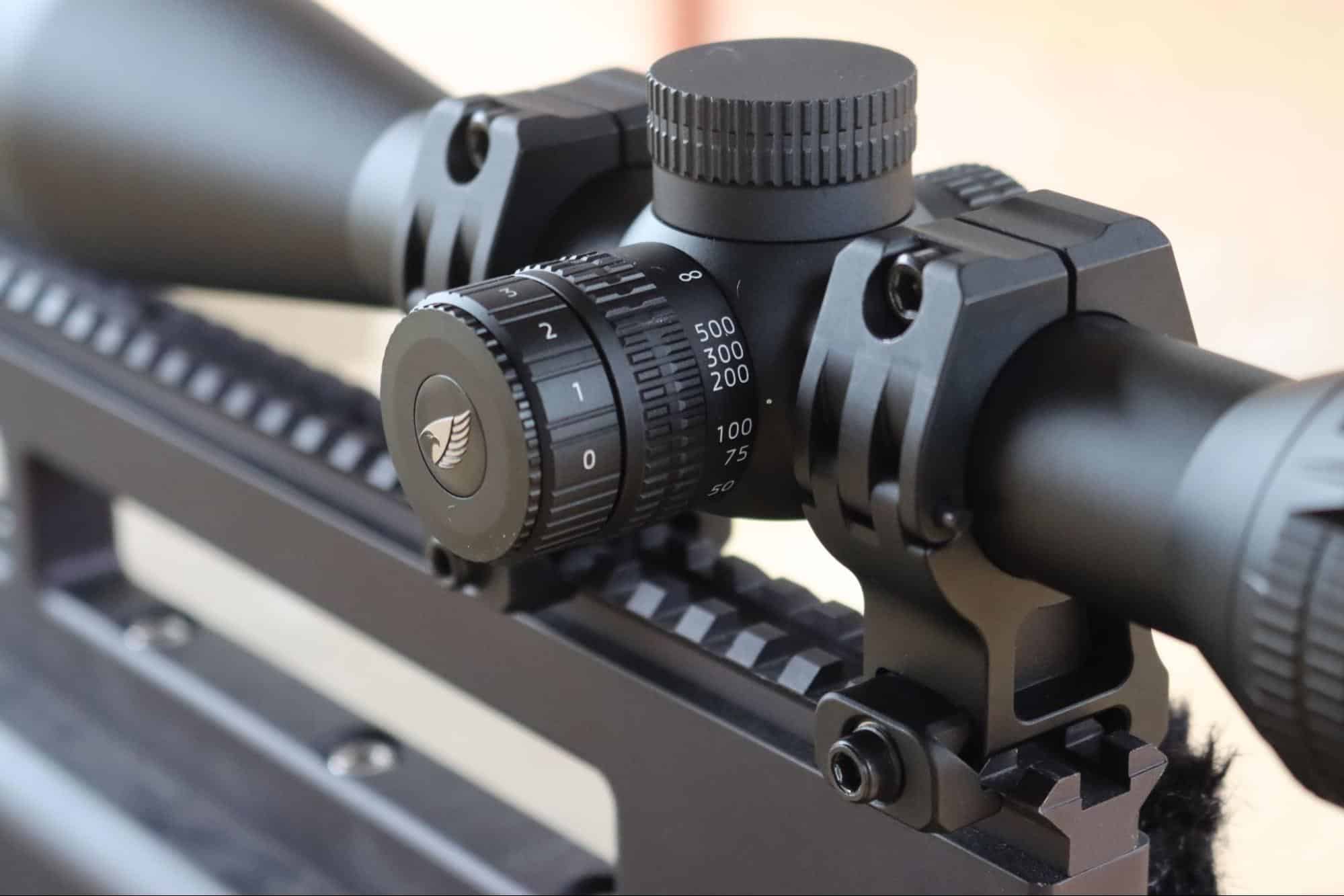
Cracking the Code on Your Scope
A label like 3-18×444 can look like a secret handshake, but it really describes just two things: how much the scope magnifies and how wide its front lens is.
At a Glance:
- The first number is magnification, or how many times closer the target looks than it does to the naked eye
- The second number is the objective lens diameter in millimeters, which sets how much light the scope pulls in
- Exit pupil, tube size, and MOA or MRAD turret values are the next numbers worth knowing
- Fixed magnification and variable magnification each earn a place, depending on how you shoot
- Matching a scope’s numbers to your game, your terrain, and your shot distances beats chasing the biggest spec
Every rifle scope prints its core specs right on the tube or the box. Once you can read those few numbers, you can size up almost any scope on the shelf in a matter of seconds.
What Do the Numbers on a Scope Mean?
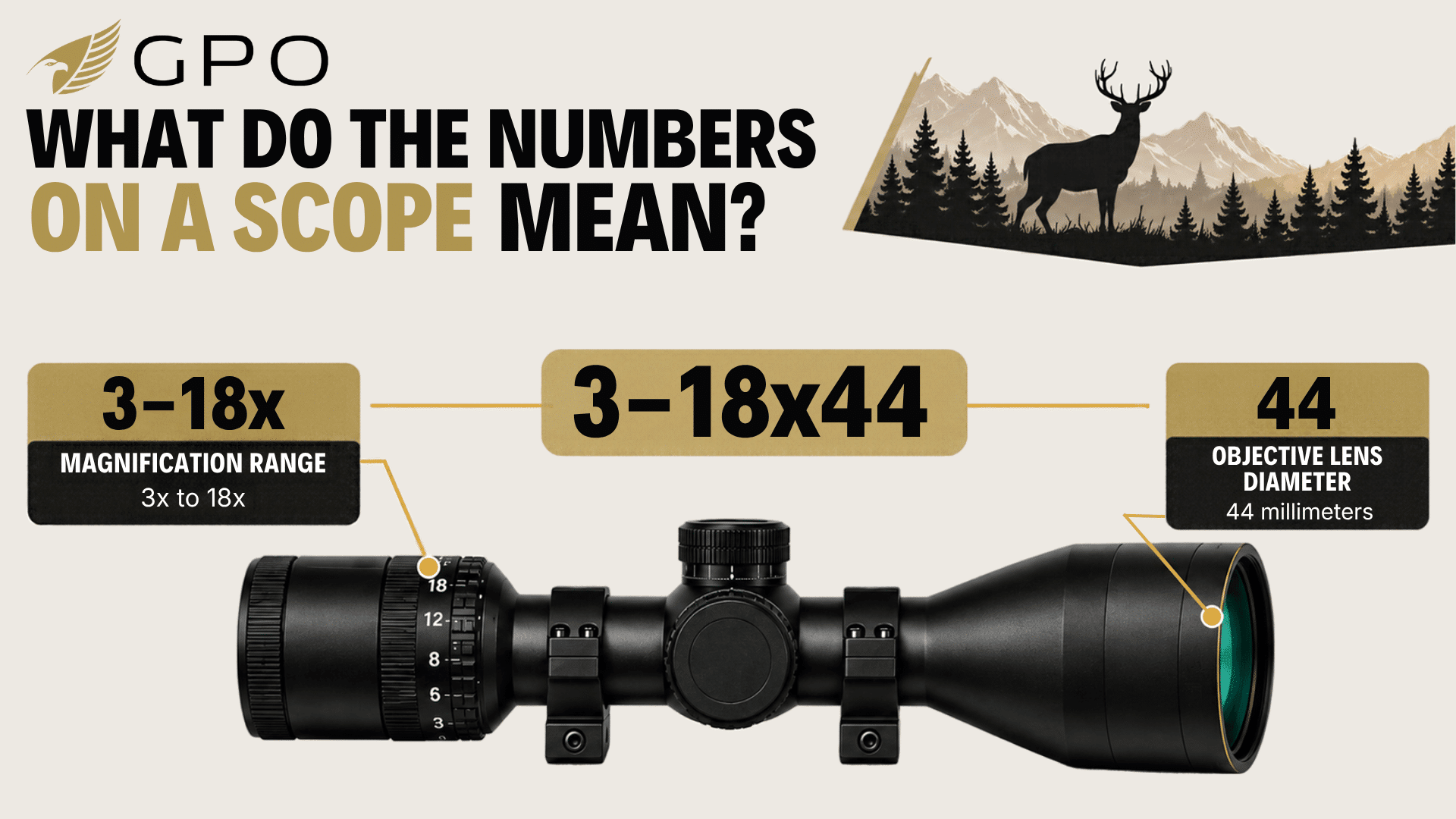
The numbers on a scope describe its magnification and objective lens diameter, written as magnification x objective. On a 3-18×44, the 3-18 is a magnification range from 3x to 18x, and the 44 is a 44mm objective lens. A single figure like 4×32 means fixed magnification at one power only.
Those two values do most of the heavy lifting, so they belong on the box and the tube. The rest of a scope’s numbers, covered further down, fine-tune the picture and the aiming system once you understand the main two.
The First Number: Magnification
The first number is magnification power, meaning how many times larger the target appears than it does to the naked eye. One figure like 4x is fixed magnification. A range like 3-9x is variable magnification you dial, where the first number is the lowest power and the second number is the highest power in the magnification range.
Lower power gives a wider field of view and faster target acquisition up close, which helps in timber. Higher magnification narrows that view but lets you place a precise shot at a greater distance. This is why a wide magnification range like 3-18x has become the do-it-all standard for hunters who shoot at different distances.
The Second Number: Objective Lens Diameter
The second number is the objective lens diameter in millimeters, measured across the front lens that faces your target. A larger objective lens gathers more light, which sharpens the image in low-light conditions at dawn and dusk. The trade-off is that a bigger objective lens size adds weight and rides higher over the bore.
Bigger is not automatically a better option. Glass quality and lens coatings decide how much of that gathered light actually reaches your eye, so a well-built 42mm scope can outperform a cheap 50mm. For most hunting, an objective in the 40mm to 44mm range balances brightness against weight.
Reading a Full Spec at a Glance
The fastest way to read any scope is to split the label into magnification and objective, then judge it against your shooting. The table below maps common configurations to the work they suit, from close timber to long-range shooting.
| Scope Spec | What it Means | Best Suited For |
| 1-6×24 | Variable 1x to 6x, 24mm objective (GPOTAC, SPECTRA) | Fast, close shots and moving game |
| 2.5-10×44 | Variable 2.5x to 10x, 44mm objective (SPECTRA) | All-around hunting at common ranges |
| 3-12×42 | Variable 3x to 12x, 42mm objective (PASSION HDi) | Versatile hunting in mixed cover |
| 3-18×44 | Variable 3x to 18x, 44mm objective (CENTURI) | Mixed terrain out to longer ranges |
| 4.5-27×50 | Variable 4.5x to 27x, 50mm objective (SPECTRA, GPOTAC) | Long-range precision and open country |
The Numbers Behind the Scope Numbers
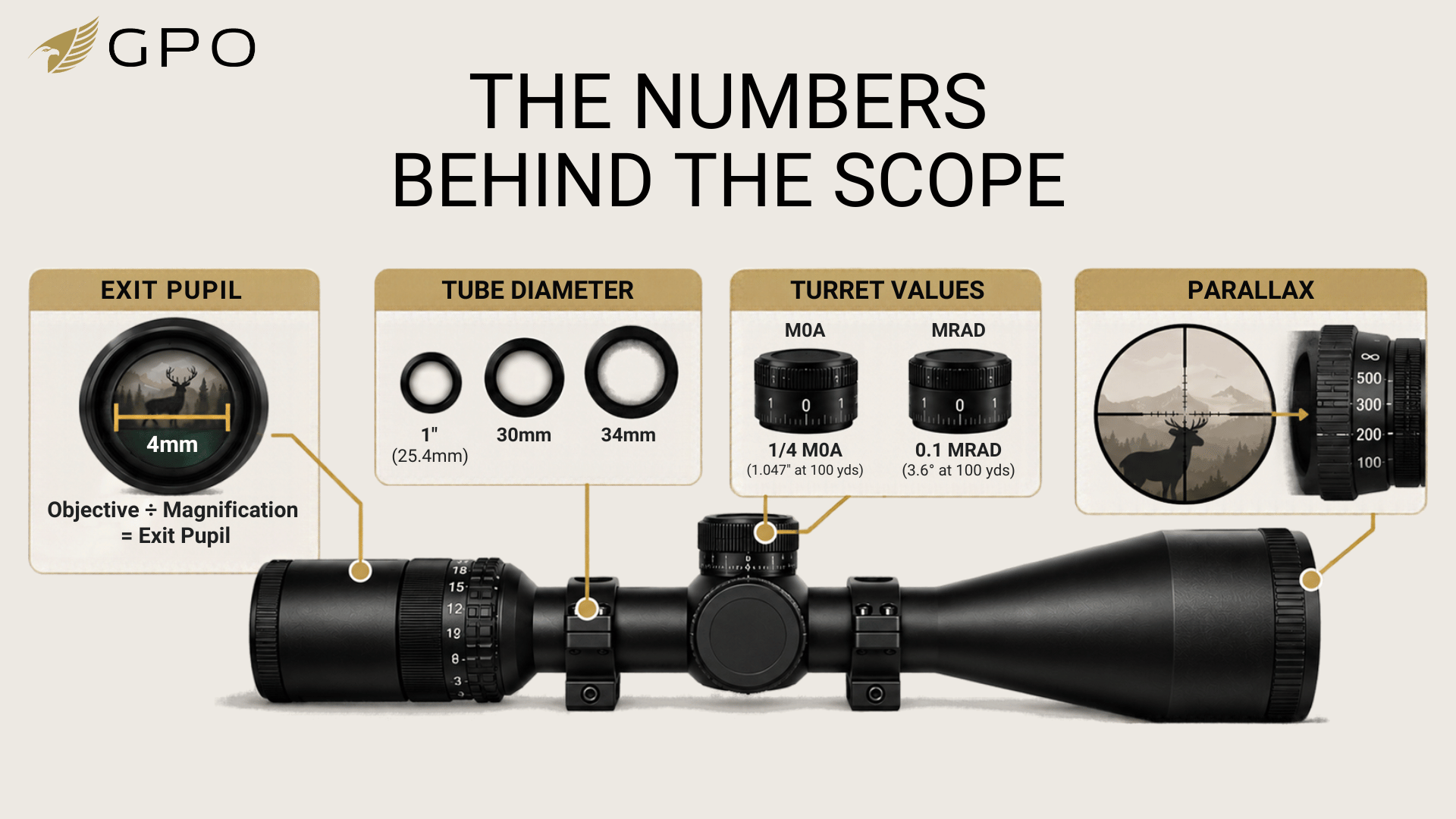
Beyond magnification and objective, a scope carries a few more numbers that shape the view and the aiming system. Exit pupil, tube diameter, turret click values, and parallax settings each tell you something specific, and knowing them helps you make an informed decision instead of guessing.
Exit Pupil
Exit pupil is the width of the light beam leaving the eyepiece, found by dividing the objective lens diameter by the magnification. A 40mm objective at 10x gives a 4mm exit pupil. A wider exit pupil feeds more light to your eye, which is what you want when the light goes flat.
There is a ceiling to how much that helps. A young eye opens to about 7mm in full darkness, and that figure shrinks as you get older. Past roughly a 5mm exit pupil, most shooters see diminishing returns, so a giant objective lens is not always the answer.
Tube Diameter
A wider tube does not make the image brighter, but it can give the scope’s internal aiming mechanism more room to move. This allows for a greater adjustment range when correcting for bullet drop or wind at longer distances. GPO’s GPOTAC line rides on 34mm tubes, while the CENTURI line uses 30mm.
MOA and MRAD Turret Values
Turret numbers tell you how far each click moves your point of impact, in one of two angular systems. On a MOA scope, 1 MOA equals about 1.047 inches at 100 yards, and clicks are usually 1/4 MOA. On an MRAD scope, one mil equals roughly 3.6 inches at 100 yards, with 0.1 mil clicks.
Neither system is more accurate than the other. Pick the one that matches how you think and how your shooting partners talk, then stick with it so your holds and dials stay consistent.
Parallax and Focal Plane
Two more settings round out the picture. Parallax shows up as the reticle appearing to drift on the target when your eye moves off center, and a side parallax adjustment marked in yards corrects it at high magnification. Focal plane decides whether the reticle grows with the image or holds one size:
- A first focal plane reticle keeps its holdover values true across the entire magnification range, which long-range shooters rely on
- A second focal plane reticle stays the same visual size at every power and reads clean in close cover
- Eye relief is the distance the scope sits from your eye, is listed separately and keeps the ocular off your brow under recoil
How to Choose the Right Numbers for You
Match the numbers to your typical shot, not the largest spec sheet. Think about your longest realistic distance, the light you usually hunt in, and the weight you want to carry. From there, a short checklist points you to the right magnification range and objective for your specific requirements.
- Close Timber and Fast Shots: lower variable magnification like 1-6x or 2-10x with a wide field of view
- All-around Hunting at Different Distances: a 3-9×40 or 4-16×44 covers most work
- Open Country and Long Distance: higher magnification and a 44mm to 50mm objective for long-range precision
- Low-light Conditions: prioritize glass quality and a sensible exit pupil over raw objective size
- Varied Weather Conditions: sealed, nitrogen-purged scopes hold up when the lighting conditions and temperature swing
The Numbers Are Only as Good as the Glass
Two scopes can share identical numbers and still look nothing alike through the eyepiece, because the glass and coatings decide how much light actually gets through. Every uncoated air-to-glass surface reflects about 4% of the light hitting it, so quality coatings are what separate a bright scope from a dim one.
The same light-gathering principle runs through every optic you carry. The binoculars you glass with at first light, the rangefinding binoculars that confirm the distance, and the spotting scope that sizes up an animal before the stalk all live or die on light transmission, the share of available light the glass actually delivers to your eye. GPObright coatings push that figure up toward 92% across the full optical system, and Double HD glass sharpens resolution when the light goes flat. A thermal scope works differently, since it reads heat instead of visible light, and its numbers describe sensor resolution rather than an objective lens.

Find the Right Scope at GPO USA
Once you can read the numbers, picking a scope gets simple. Match the magnification range and objective to your game, your ground, and your light, then trust quality glass to do the rest. Every GPO scope is German-engineered and backed by a fully transferable Spectacular Lifetime Warranty. Browse the full lineup of GPO riflescopes to find your match, and contact the GPO team with any questions before you buy.


 Menu Close
 Menu Close